
CONJUGATED POLYMERS & INTERFACE MATERIALS
Semiconductors you can dissolve.
Organic semiconductors let a device be printed, bent, made semi-transparent or grown on plastic. A working device needs three things in the stack: a hole conductor, an electron conductor, and an interface that lets charge cross cleanly between them. Tenutec supplies all three.
SUB-GROUP 01 · HOLE CONDUCTORS
p-type polymers
PEDOT:PSS · PEDOT-F · aqueous dispersion or formulated ink
PEDOT:PSS is the workhorse of printed electronics: poly(3,4-ethylenedioxythiophene) held in water by polystyrene sulfonate, giving a transparent, mechanically compliant film that conducts holes well enough to replace indium tin oxide in many stacks. It coats from water, tolerates flexing, and has a work function that suits it to hole extraction and injection alike.
Its limits are equally well known. The PSS phase is acidic, hygroscopic and insulating, so conductivity depends heavily on post-treatment, and film stability in humid conditions is the usual failure mode. Tenutec's work concentrates on the formulation and cross-linking chemistry that addresses this including photopatternable PEDOT:PSS hydrogels that can be defined by photolithography at high resolution, and DVS cross-linked coatings that survive in water.
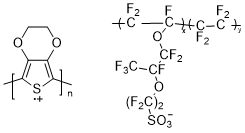
PEDOT-F is our fluorinated PEDOT variant. Replacing the PSS environment with a fluorinated counterion system raises hydrophobicity and shifts the work function, which improves film stability under humidity and gives a deeper, better-matched energy level for hole extraction in several device architectures — at the cost of a different processing window from standard PEDOT:PSS.
Both are supplied as aqueous dispersion or as a formulated ink at a set concentration and solvent system, filtered and specified for spin-coating, blade-coating or slot-die processing.
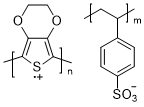
The standard transparent hole conductor. A polythiophene backbone held in water by a polyanion, giving a flexible, printable film that replaces ITO in many stacks. Supplied as aqueous dispersion or formulated ink, including our cross-linked and photopatternable grades.
Tenutec's fluorinated PEDOT grade. Replacing the PSS environment with a fluorinated counterion raises hydrophobicity and deepens the work function, improving film stability under humidity and energy-level matching for hole extraction. Different processing window from standard PEDOT:PSS.
APPLICATIONS
Hole transport layers. Organic and perovskite solar cells, OLEDs and light-emitting electrochemical cells.
Transparent electrodes. An ITO replacement where flexibility or cost rules out sputtered oxide.
Organic thermoelectrics. p-type legs in printed, flexible thermoelectric generators.
Bioelectronics. OECT channels and low-impedance electrode coatings for tissue-contacting devices.
Supercapacitors and energy harvesting. Cross-linked PEDOT:PSS and CNT composite electrodes, and transpiration-driven power generators.
Antistatic and EMI coatings. Transparent conductive layers on plastic film.
SELECTED PUBLICATIONS
SUB-GROUP 02 · ELECTRON CONDUCTORS
n-type polymers
PBFDO · self-doped · solution-processable · air-stable
Organic electronics has a long-standing asymmetry: p-type materials are plentiful, stable and commercially available, while good n-type conductors are rare. The reason is chemical rather than accidental an n-doped polymer carries electrons in a high-lying LUMO, which makes it vulnerable to oxygen and water. Most n-type materials that perform well in a glovebox degrade within hours in air, and those that survive usually depend on a bulky external dopant that then phases out of the film.
PBFDO poly(benzodifurandione) is the material that closed that gap. It is made by oxidative polymerisation with in situ reductive n-doping, so the doping happens during the polymerisation rather than as a later diffusion step. That gives a doping efficiency approaching one charge per repeat unit and, unusually, a backbone that is solution-processable with no solubilising side chains or surfactants at all.
The consequences are practical. Conductivity above 2,000 S cm⁻¹ puts PBFDO within reach of PEDOT:PSS on the p-side, making a genuinely matched complementary pair possible for the first time. Films are stable in ambient air and humidity, resist common organic solvents and acidic and basic media, and need no inert atmosphere to process so a device can be built on a bench rather than in a glovebox.
Tenutec supply PBFDO as solid or as a formulated ink at a set concentration, with conductivity, energy levels and film data reported per batch. Where a customer needs a matched pair, it is characterised alongside our p-type materials on the same substrates and the same measurement setup, so the comparison that goes into a device model is like for like.
APPLICATIONS
Organic electrochemical transistors. The n-channel material for complementary OECT amplifiers and logic operating in aqueous media.
Organic thermoelectrics. The n-type leg that has historically limited printed thermoelectric generators.
Electron transport layers. Organic and perovskite solar cells, photodetectors and OLEDs.
Complementary circuits. n-channel devices for inverters and logic on flexible substrates, paired with a PEDOT p-channel.
Bioelectronics and neural interfaces. Low-impedance, water-stable coatings on tissue-contacting electrodes.
Electrochemical energy storage. Conducting binders and redox-active electrode additives.
SELECTED PUBLICATIONS
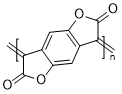
The n-type counterpart to PEDOT. Made by oxidative polymerisation with in situ reductive n-doping, reaching close to one charge per repeat unit, and solution-processable with no solubilising side chains at all. Stable in ambient air, humidity, and acidic and basic media.
SUB-GROUP 03 · INTERFACE MATERIALS
Self-assembled monolayers
Carbazole-based SAMs · phosphonic acid anchoring · hole-selective contacts
A self-assembled monolayer is the thinnest functional layer in a device, a single molecule deep. One end anchors chemically to the electrode oxide, the other end presents a chosen chemistry to the active layer, and the molecule in between sets the work function. Replacing a tens-of-nanometres hole transport layer with a monolayer removes almost all of its series resistance and parasitic absorption while giving finer control over the energy-level alignment at the contact.
Carbazole-based SAMs with phosphonic acid anchoring groups have become the standard hole-selective contact in high-efficiency perovskite cells, and Tenutec's founding researcher have been extending them to organic solar cells. The design questions are specific and answerable: how many substituents the carbazole carries, how long the alkyl spacer is between the anchor and the core, and whether one molecule or a co-assembled mixture gives better surface coverage.
Each of those has produced a result. Monosubstituted carbazole SAMs delivered organic solar cells at 20.12% efficiency. Varying the alkyl spacer length showed how molecular conformation on the surface controls device performance, rather than the electronic structure alone. Layered co-assembly, where a second molecule fills the defects the first leaves behind, gave 20% cells and 17% mini-modules the module figure being the one that matters for anything headed toward manufacture.
SAM materials are supplied as solid for the customer's own deposition, with recommended deposition conditions and the substrate and concentration windows we have validated.
APPLICATIONS
Organic solar cells. Hole-selective contact replacing PEDOT:PSS, with certified performance above 20%.
Perovskite and tandem cells. The established hole contact for inverted perovskite architectures.
Mini-modules and scale-up. Co-assembled SAMs giving uniform coverage over module-scale substrates.
Photodetectors. Low-resistance selective contacts where dark current sets the detectivity.
Work-function engineering. Tuning a transparent oxide electrode without adding a bulk layer.
SELECTED PUBLICATIONS
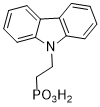
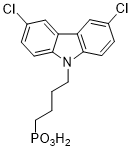
A single SAM never covers a surface perfectly, and the gaps it leaves are recombination sites. Co-assembly puts a second, smaller molecule into those gaps. This is what took our cells to 20% and mini-modules to 17% the module figure being the one that matters for manufacture.
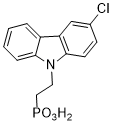
Chlorine pulls the HOMO deeper than the unsubstituted carbazole and adds a halogen-bonding interaction with the layer above, which can passivate the interface as well as align it. Reported in organic cells around 20.1% efficiency.